Explore the Church
St. Andrew's Church Heritage Trail
St. Andrew's has welcomed pilgrims over many centuries who have often remarked on the peaceful, spiritual atmosphere that it holds within its walls.
Church History
The church was built in three phases — the Chancel in the 1200s, the Nave in the 1300s and finally the Tower in the 1400s. In the 1850s, the Nave and Chancel were substantially rebuilt in their original style. Please enjoy the variety of local history on show, the stained glass and the many monuments located around the church.
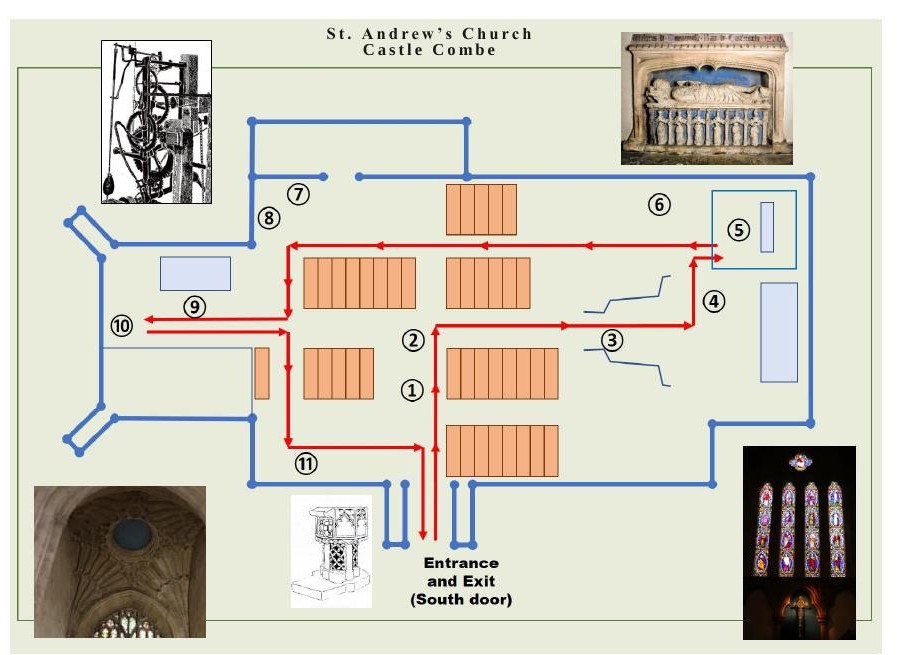
The Eleven Trail Stops
The Font
Positioned by the south door, the font dates from 1450. Unusually, it has a rest for the Priest's service book.
Coat of Arms, Chancel Arch, Rose Window
The Royal Coat of Arms above the south door shows the Arms of Charles II — the Lion and Unicorn, no longer fighting for the Crown, sitting down having a well-earned rest. The Chancel Arch shows six saints carved in canopied niches, including St. Andrew (saltire cross), St. James (Patron Saint of Pilgrims, with his scallop shell badge), and two unknown female saints. The church sits on the ancient pilgrim route between Glastonbury and Malmesbury. Above is the circular Rose Window.
The Organ
Built by Norman and Beard of Norwich in 1911, the organ sits behind the south choir area. It was a gift from Miss Eva Gorst in memory of her brother Sir Eldon Gorst, and was rebuilt by the original builders' successors in 1988.
Jesse Window
The huge window behind the altar shows the genealogy of Christ from Jesse, to David, to Joseph. The stained glass is a Victorian imitation of the original Norman glazing.
Medieval Screen
In 2018, the old vestry was relocated from the Knight's Chapel to a new annex as part of the "Make History" project. The plywood covering the old screen was removed and restoration allowed access to the chapel, now a quiet space for reflection and prayer.
The Knight's Chapel
A late 13th-century canopied tomb effigy of Walter de Dunstanville, Baron of Castle Combe in 1270 and great-great-grandson of Henry I of England. He is depicted in chain mail; his drawn sword and feet resting on a lion suggest he died in battle, while his crossed legs suggest he went on two Crusades. The six "weepers" below are thought to be his children.
History of Castle Combe
Display boards outlining the history of the church and the village.
Filming of "War Horse"
In 2011, scenes from the film were shot in Castle Combe. A photo display shows the period wartime atmosphere recreated by the film crew.
Faceless Clock
Villagers once told the time by the bell chiming each hour. This is one of the oldest working clocks in the country, thought to have been built by a local blacksmith in the 1400s.
The Tower
Building began in 1434, funded by local wool and cloth tradesmen — particularly through the will of Sir John Fastolf, formerly Lord of the Manor. Look up to see the dramatic fan-vaulted ceiling. The inscription under the West Window, restored in 2011, reads: "This is none other but the house of GOD, and this is the gate of Heaven" (Genesis 28:17).
Cards, Guidebooks and Small Gifts
All items are sold to raise funds for the upkeep of the church. The current priority is repairing the southern roof slopes to stop water leaks, and conserving the children's altar area and the ascending angels flanking the Chancel Arch.
Visiting & Supporting the Church
St. Andrew's is a Grade I listed village church. There is no charge for entry, but the church relies on donations from visitors to cover maintenance and running costs of over £500 a week, and to enable its outreach and ministry.
- Donate using the contactless machine or the donation box in the church, or by bank transfer or cheque — details here.
- Text BYBROOK 5 to 70085 to donate £5, or BYBROOK 10 to donate £10 (plus one standard rate message).
Eco Church
The volunteer team at St. Andrew's works hard to improve environmental standards both inside the church and in the churchyard. It is a recognised "Eco" church, holding a Silver award from the A Rocha award scheme. You can read more at ecochurch.arocha.org.uk.